
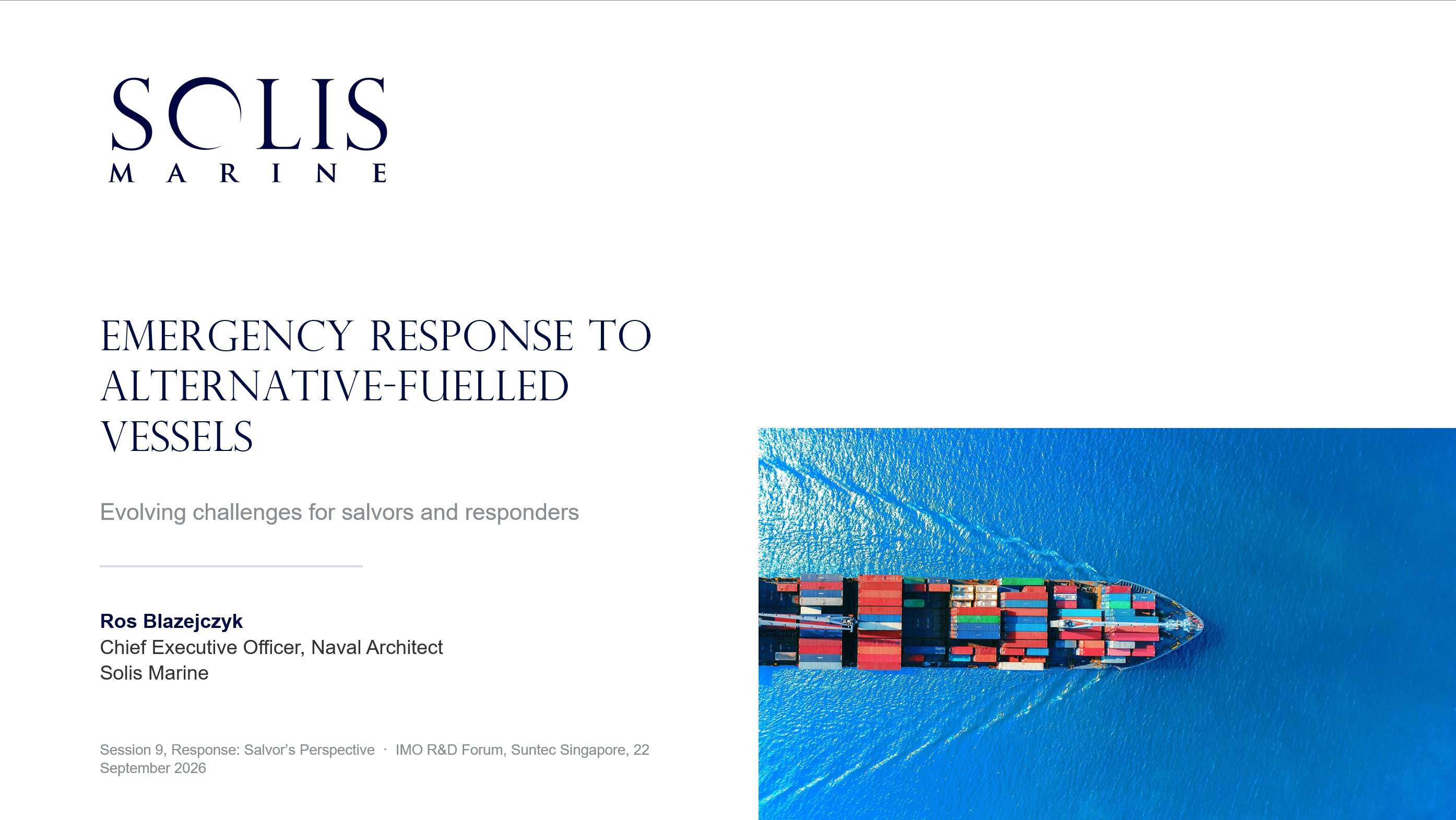
On 21 and 22 September 2026, the International Maritime Organization held its Research and Development Forum in Singapore under the theme “From fossil to future: Marine pollution preparedness in the age of alternative fuels.” Singapore co-hosted the Forum, and it ran in collaboration with SpillAsia 2026. It brought together maritime authorities, response organisations, researchers, insurers and classification societies to identify the knowledge and capability gaps in responding to spills of LNG, LPG, methanol, ammonia, hydrogen, and bio and e-fuels.
Rosalind Blazejczyk, Chief Executive Officer of Solis Marine and a naval architect, spoke on 22 September in Session 9, Response: Salvor’s Perspective. Her presentation was titled “Emergency response to alternative-fuelled vessels: evolving challenges for salvors and responders.” The rest of the panel were salvors, so her talk added the vessel design perspective to the discussion.
Ros opened with three examples of ammonia in service. In Belgium in 1942 and 1943, a wartime diesel shortage led to around 100 public buses being converted to run on liquid ammonia. They covered more than 100,000 km without an accident or spill. On the International Space Station, ammonia is the working fluid in the external thermal control system. The crew cannot evacuate, so containment relies entirely on design: full segregation from habitable volume, with detection and isolation. In June 2026, MGC ANTWERPEN was delivered as the world’s first ammonia dual-fuel oceangoing vessel. The vessel is a 46,000 m³ midsize gas carrier and the first of four.
The design regime for ammonia-fuelled ships begins with inherently safe layout. Fuel tanks and fuel equipment are sited away from accommodation and from areas at risk of collision damage. Toxic zones are defined around potential sources of release, and no release to atmosphere is permitted in any normal or foreseeable abnormal scenario. Emergency releases are provided for separately.
The protective measures form a chain: segregation, secondary enclosures, leak detection, automatic isolation, and ventilation. Ros’ message to responders was that every link in this chain assumes the vessel has power, its enclosures are intact and it is upright. A casualty can remove all three assumptions.
At equal temperature, ammonia vapour is lighter than air. A pressurised release behaves differently. It flashes, entrains moisture, and forms a cold cloud that is denser than air and stays close to the surface until it warms. Ammonia’s flammable range is narrow and its ignition energy is high, so toxicity is the dominant hazard rather than fire. Standard reference texts describe ammonia vapour as buoyant, and responders who rely on that description can misjudge the early behaviour of a release. Solis Marine supports doctoral research on this subject. Jun Hao Liew is using CFD modelling in OpenFOAM to predict ammonia dispersion in bunkering scenarios, with Newcastle University in Singapore. You can read about that work here.
Ros drew on ITOPF’s 2024 reports on the fate and behaviour of alternative fuels, prepared for the International Group of P&I Clubs. When ammonia is released to sea, roughly 60% dissolves and 40% evaporates, leaving a caustic surface layer. Methanol is fully miscible. LPG, LNG and hydrogen are insoluble and present fire and explosion hazards. For all of these fuels, the response is natural attenuation. Biofuels are the only fuel in the group that requires conventional clean-up. For the rest, the responder’s task is no longer to recover product. It is to manage exposure and keep people at a safe distance.
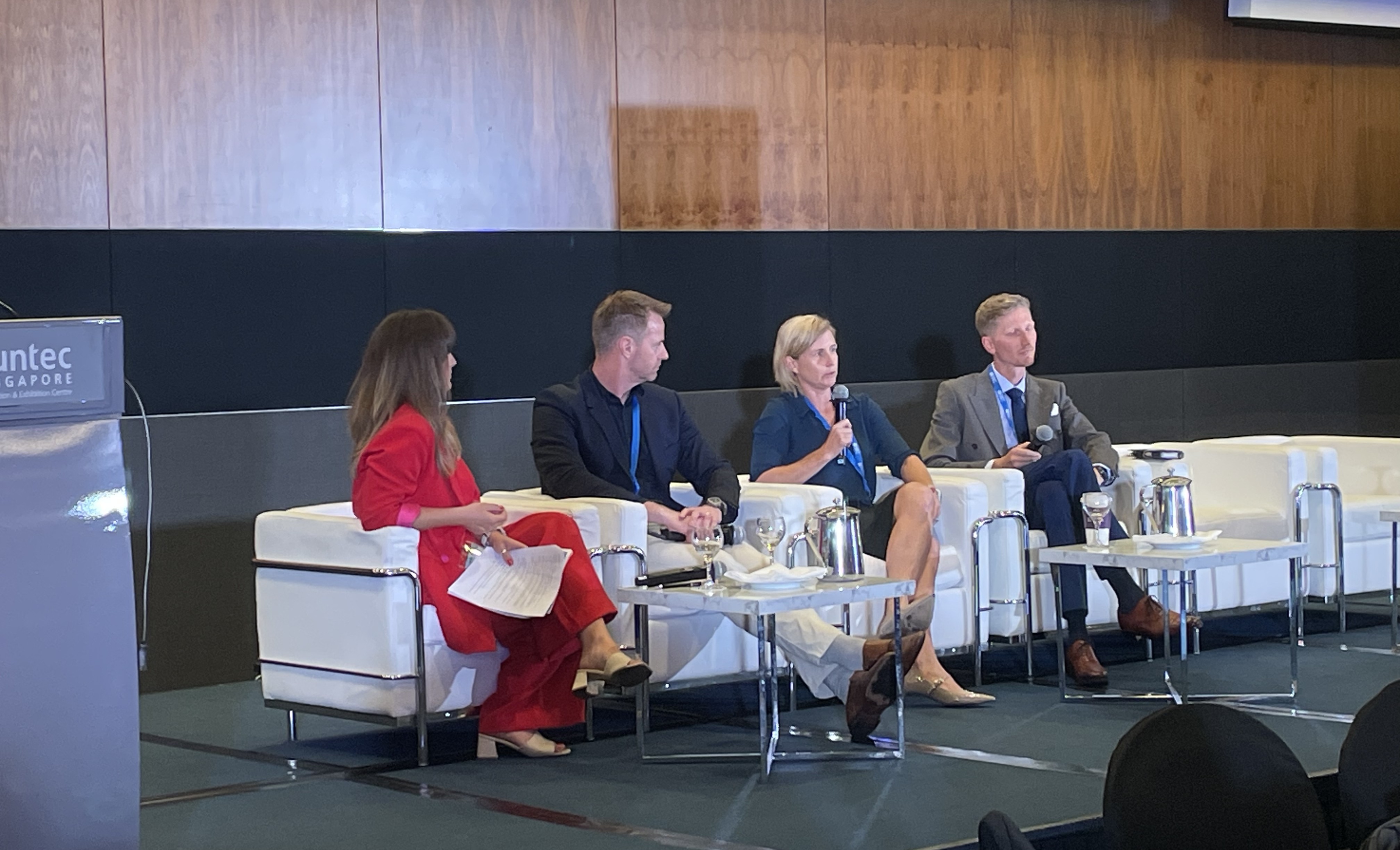
Ros closed with questions for the panel rather than conclusions. The traditional presumption in favour of removing fuel from a casualty was driven by pollution risk, so should the fuel now be contained on board or removed? Should the salvor’s first action become standing by and assessing from a distance, rather than boarding? All of these substances already travel at sea as cargo, so does it change much for the salvor when the same substance is the fuel? Vessel values will likely be higher and immediate environmental risk lower, how will Lloyd’s Open Form work in these cases? And is SCOPIC still relevant?
The Forum’s outcomes report is expected to set out a research and development roadmap for alternative fuel response. Solis Marine will continue to contribute to that work through our naval architecture, salvage and research teams.
Rosalind presented a case study at SpillAsia 2026 later the same week, and Jun Hao presented his research there as a poster.
Solis Marine is an independent marine consultancy providing casualty management, naval architecture, engineering and expert witness services worldwide. For more information, contact the team at www.solis-marine.com.