

Assessing the fuel performance of a modern LNG carrier might appear straightforward: compare actual fuel consumption with the expected figure. In practice, dual-fuel engines, cargo boil-off gas and energy-saving technologies introduce additional complexity. A review of published engineering research, technical standards and industry guidance highlights five important considerations.
1. Gas and fuel oil must be compared on anenergy basis
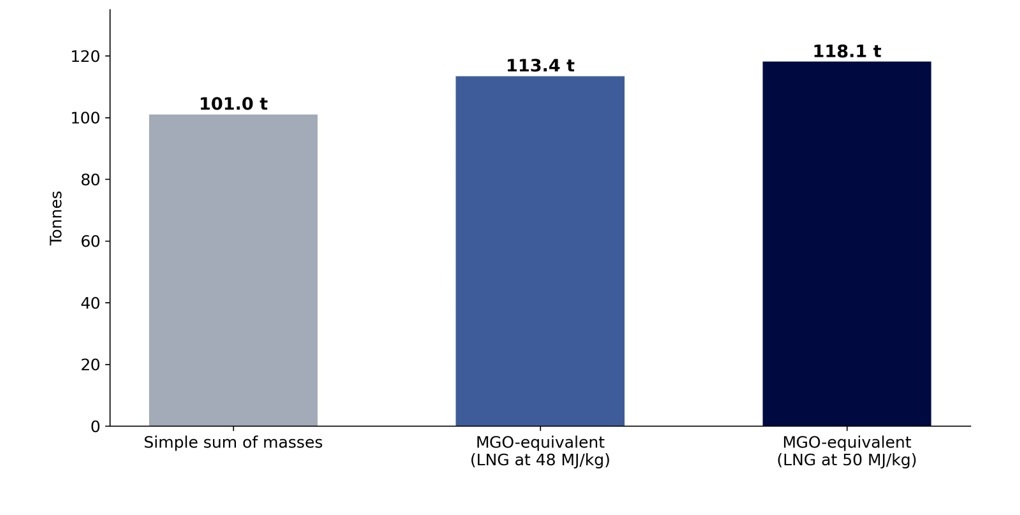
In gas mode, dual-fuel engines burn natural gas and liquidfuel together, and a tonne of gas contains more energy than a tonne of marinegas oil (MGO). Adding the two masses together does not accurately represent theMGO-equivalent consumption. The correct approach multiplies each fuel's mass byits calorific value and expresses the total as an MGO-equivalent, and theresult also depends on which reference value is used for LNG.
The chartbelow compares three totals for an illustrative day on which an engine burns100 t of gas and 1 t of pilot fuel. The first simply adds the masses. The othertwo convert both fuels to MGO-equivalent, each using a different recognisedcalorific value for LNG.
Figure 1 below shows how the same fuel can look up to 17% bigger once you count its energy instead of its weight.
The calorific values used should therefore always be stated and should reflect the fuels actually consumed.
2. Gross and net calorific values are not interchangeable
The gross calorific value (GCV) includes the heat released when the water formed during combustion condenses. An engine does not recover that heat, because the water leaves in the exhaust as vapour, so engine performance is stated on a net basis.

For natural gas, the two values differ by approximately 10%,depending on composition, compared with about 7% for fuel oil. Using a grossvalue alongside engine data stated on a net basis can therefore introduce anerror of around 10% for gas.
3. The gas burned by the engine may differ from the loaded cargo
Natural boil-off gas does not have the same composition as the LNG it comes from. Nitrogen and methane evaporate first, so early in a laden voyage the boil-off can be nitrogen-rich and lower in calorific value than the cargo. As the nitrogen is depleted, the boil-off’s calorific value rises, far more than the cargo’s.
The chart in Figure 2 below is based on a published simulation of a 25-day laden voyage. It compares how much the calorific value of the boil-off and of the liquid cargo rose for four cargoes with different nitrogen contents.
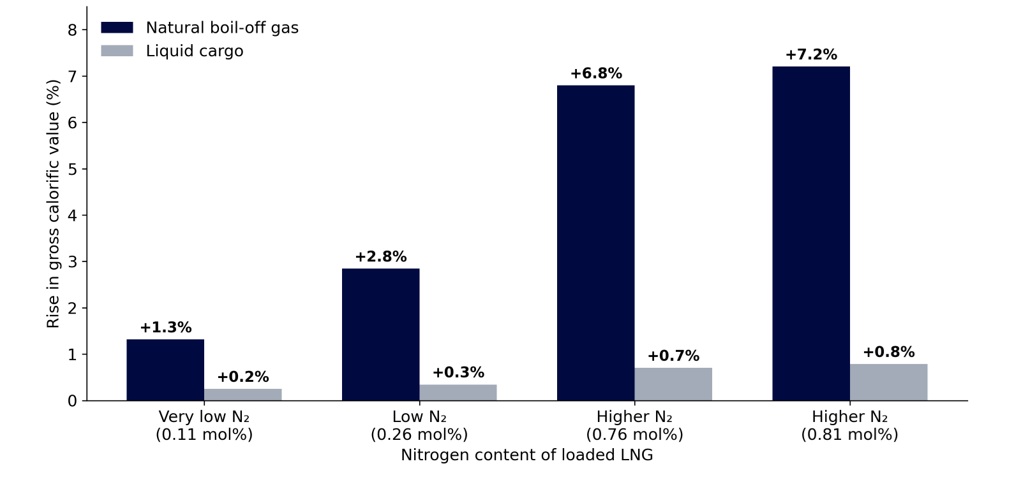
Forced boil-off gas, produced by vaporising LNG completely,takes the composition of the liquid at the time. An accurate assessmenttherefore needs to distinguish between natural boil-off, forced boil-off andmixtures of the two.
4. Energy-saving technologies must be assessed under actual operating conditions
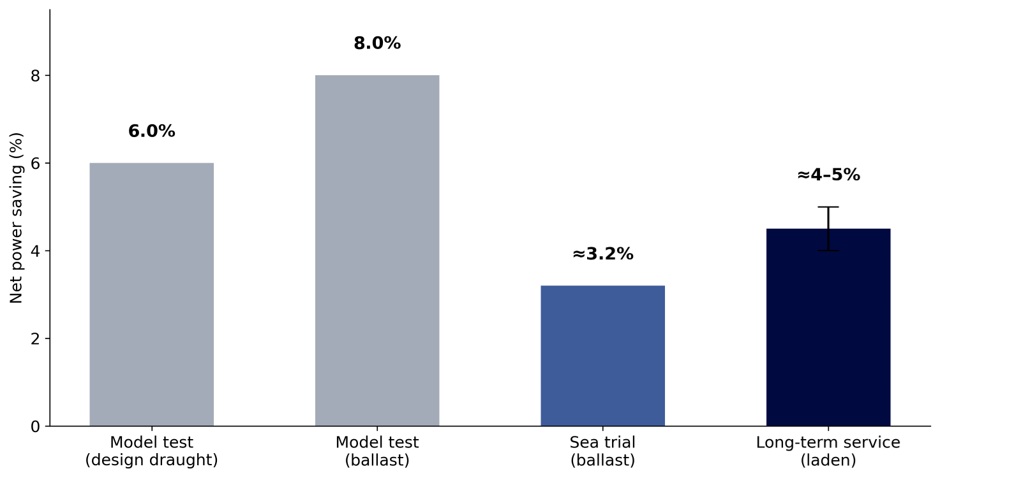
Air lubrication systems reduce frictional resistance byintroducing air beneath the vessel, but the compressors that supply the airtypically consume 3–5% of propulsion power, and the net benefit depends onspeed, draught, sea conditions and hull coverage. Results at sea can fall shortof model-test predictions.
The chart in Figure 3 below follows one large LNG carrier from model tests, through its sea trial, to long-term service, showing the net power saving at each stage.
Shaft generators produce electrical power from the main engine instead of the auxiliary generators. Their benefit depends on how much more efficient the main engine is, a gap that narrows considerably when both engines burn gas:

For the LNG carrier, a published modelling study estimated an overall saving of under 2% of total energy, with the shaft generator usable only at normal seagoing speeds, about 60% of the vessel's time. Both technologies therefore need to be evaluated against actual operating profiles rather than design assumptions alone.
5. Pilot fuel remains part of gas-mode consumption
Low-pressure dual-fuel engines ignite the gas with a small injection of liquid pilot fuel, typically about 0.5–1% of total fuel energy at full load. Because the amount stays roughly constant across the load range, its share rises at part load, and additional liquid fuel may be used to stabilise combustion in some modes. A complete assessment of gas-mode performance must include both fuels.
Summary
An accurate assessment of LNGcarrier fuel performance depends on five factors:
- Energy, not mass: gas and liquid fuel must be combined on their energy content, using stated calorific values that reflect the fuels burned.
- Gross versus net: custody transfer uses gross calorific values and engines use net values; for natural gas they differ by about 10%, so the two must not be mixed.
- The gas burned is not the cargo loaded:natural boil-off differs in composition from the cargo, and its calorific value can change over a voyage, far more than the cargo's.
- Energy-saving technologies depend on conditions: Air lubrication often delivers less in service than model tests predict, and shaft generators save less on gas than on diesel and run only at seagoing speeds.
- Pilot fuel is always present: low-pressure dual-fuel engines burn a small amount of liquid fuel in gas mode, and its share rises at part load.
The methods for determining fuel properties are well established in standards and guidelines such as ISO 6976 and the GIIGNL LNG Custody Transfer Handbook [JL1] .The challenge lies in applying them consistently to real-world vessel performance.
Get in touch
To discuss LNG carrier fuel performance, dual-fuel consumption calculations or the assessment of energy-saving technologies, contact the Solis Marine team.
This article summarises publicly available technical literature and industry guidance for general information. It does not assess any specific vessel or contractual arrangement.
[JL1]This is not a standard but a guideline.
References
European Maritime Safety Agency. (2026). Hull air lubrication system study. EMSA. https://www.emsa.europa.eu/publications/reports/item/5633-hull-air-lubrication-system-study.html
Everllence. (2025). ME-GA engines: 1.00 The ME-GA dual-fuel engine (Project guide).https://man-es.com/applications/projectguides/2stroke/content/199145820.pdf
GIIGNL. (2026). LNG custody transfer handbook (7th ed., version7.0). International Group of Liquefied Natural Gas Importers.
International Maritime Organization. (2022). 2022 guidelines on themethod of calculation of the attained Energy Efficiency Design Index (EEDI) for new ships (Resolution MEPC.364(79)).
International Organization for Standardization. (2016). Natural gas —Calculation of calorific values, density, relative density and Wobbe indicesfrom composition (ISO 6976:2016).
Kim, S., Kim, J., & Choi, S. (2019). Development of air lubricationsystem for reduction of ship frictional drag. In Proceedings of the 11th International Workshop on Ship and Marine Hydrodynamics, Hamburg, Germany.
Kim, Y.-R., & Steen, S. (2023). Potential energy savings of airlubrication technology on merchant ships. International Journal of Naval Architecture and Ocean Engineering, 15, 100530.https://doi.org/10.1016/j.ijnaoe.2023.100530
MAN Energy Solutions. (2019). Efficiency of MAN B&W two-stroke engines: Stationary application.https://www.man-es.com/docs/default-source/document-sync-archive/efficiency-of-man-b-w-two-stroke-engines-eng.pdf
MAN Energy Solutions. (2021). Shaft generators for low speed mainengines.https://www.man-es.com/docs/default-source/marine/tools/5510-0003-03ppr.pdf
Peruško, D., Karabaić, D., Bajsić, I., & Kutin, J. (2023). Ageing of liquified natural gas during marine transportation and assessment of the boil-off thermodynamic properties. Journal of Marine Science and Engineering, 11(10), 1980. https://doi.org/10.3390/jmse11101980
Souflis-Rigas, A., Prousalidis, J., & Dimopoulos, G. (2021).Assessing the implementation of Power Take Off (PTO) system onboard liquifiednatural gas (LNG) carriers. In 2021 IEEE Electric Ship Technologies Symposium (ESTS). https://doi.org/10.1109/ESTS49166.2021.9512353
Win, G.D. (2021). Marine installation manual: X72DF. Winterthur Gas& Diesel Ltd.
Wood, D. A., & Kulitsa, M. (2018). Weathering/ageing of liquefied natural gas cargoes during marine transport and processing on floating storage units and FSRU. Journal of Energy Resources Technology, 140(10), 102901.https://doi.org/10.1115/1.4039981