
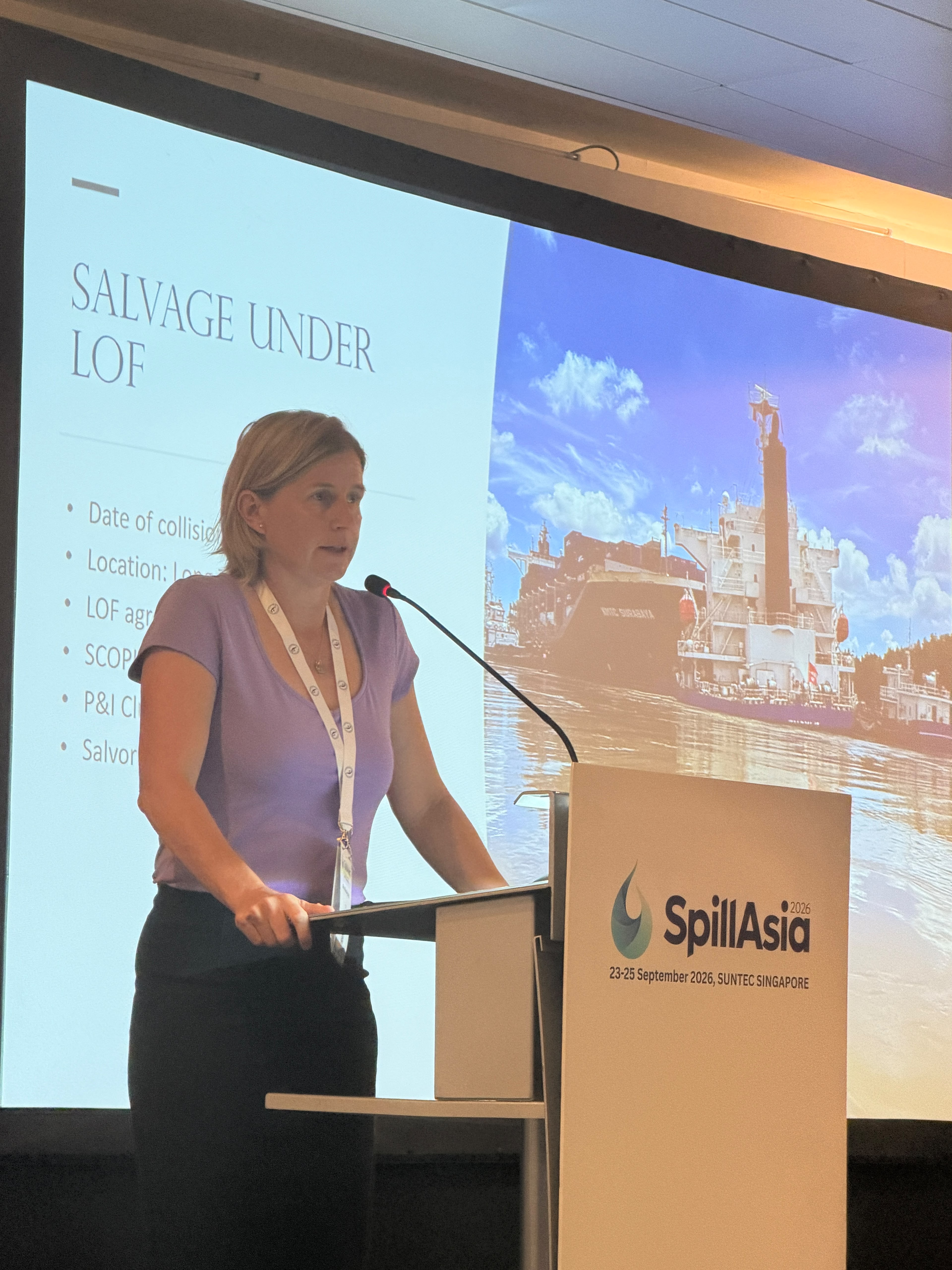
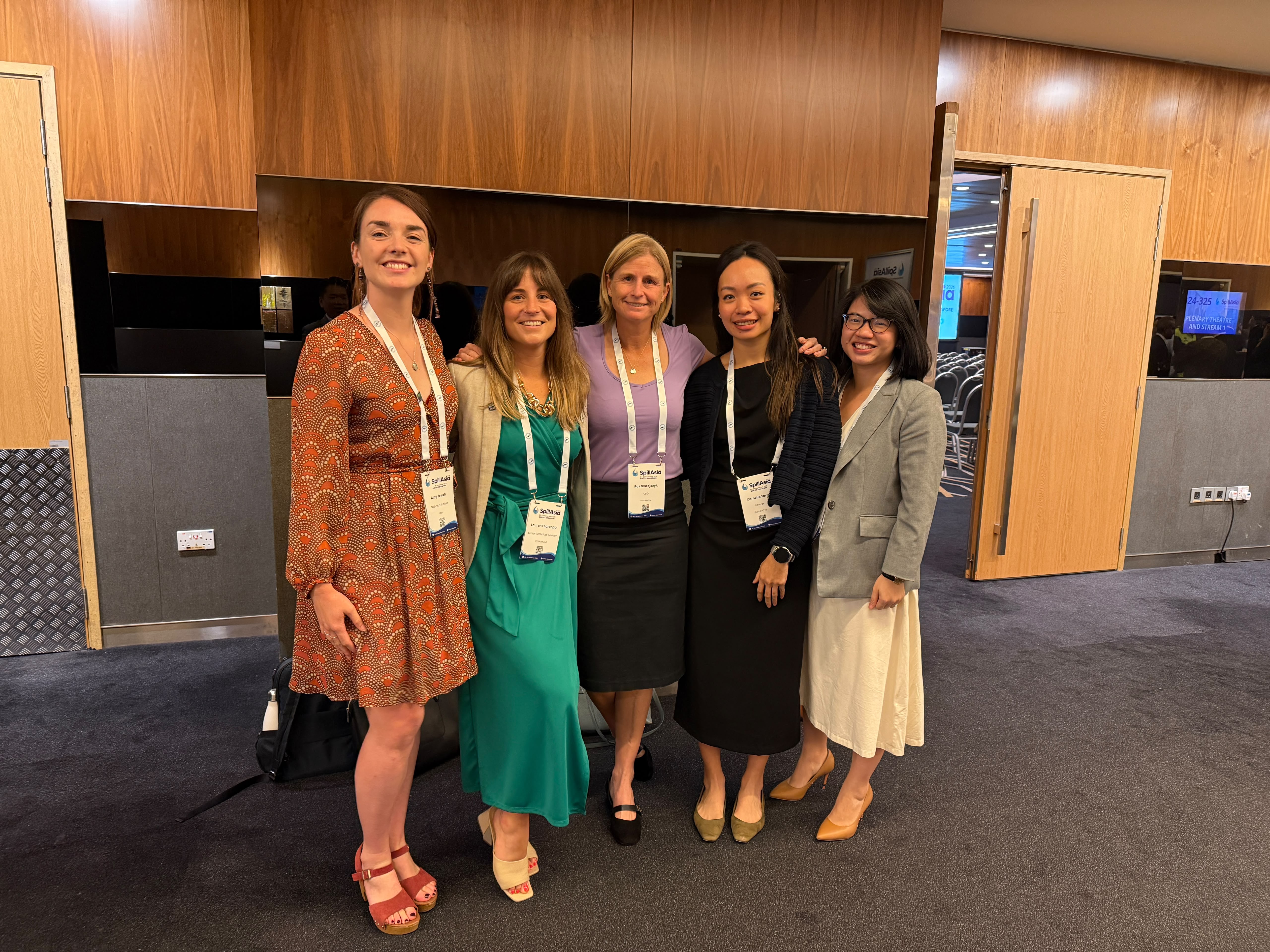
SpillAsia 2026 took place at Suntec Convention Centre in Singapore from 23 to 25 September. It is the Asia-Pacific edition of the triennial series of international spill events that includes Interspill in Europe and IOSC in the USA. It followed the IMO R&D Forum, held at the same venue earlier in the week.
Rosalind Blazejczyk, Chief Executive Officer of Solis Marine, spoke in two sessions. On 24 September, in Session 7, Panel Session: Lessons learned from recent regional incidents, she presented the salvage of the bulk carrier ‘GLENGYLE’ in Vietnam in 2025. On 25 September, in Session 17, Case Studies: Learning outcomes from marine incidents, she presented the technical and commercial coordination of the ‘MARINE HONOUR’ oil spill in Singapore in 2024.
On 25 April 2025, the Handymax bulk carrier ‘GLENGYLE’, loaded with 16,832 tonnes of steel products bound for Australia, was struck by a container vessel in the Long Tau River, Ho Chi Minh City. The collision breached two fuel tanks, releasing approximately 290 tonnes of HFO, and two cargo holds. The Salvor was engaged under Lloyd’s Open Form on 26 April, and Gard, as P&I insurers, appointed Solis Marine the same day. When the Salvor invoked SCOPIC on 29 April, Ros became the Special Casualty Representative (SCR), representing all salved interests.
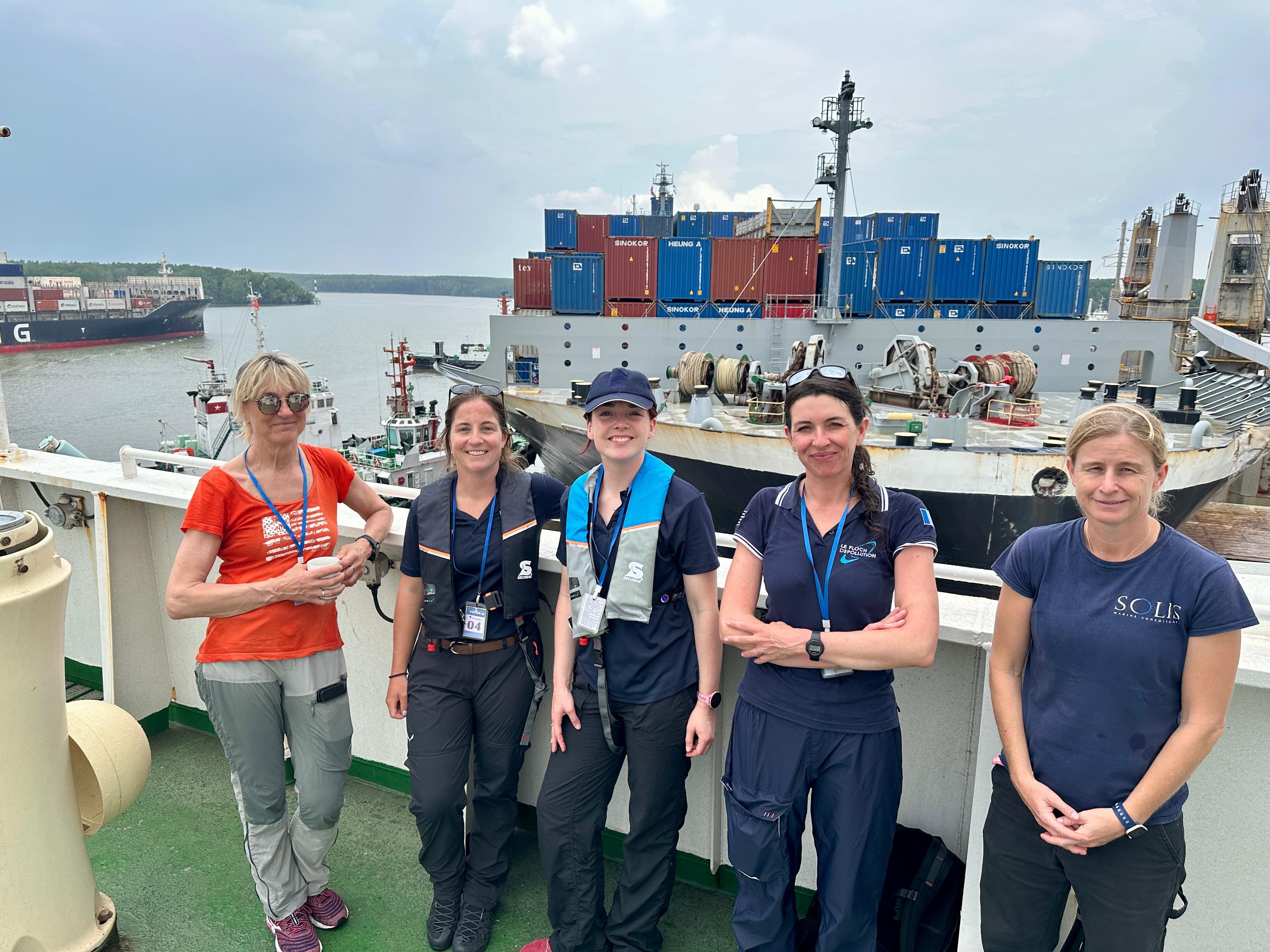
Tugs held both vessels clear of the navigation channel while the vessel was stabilised, oil was skimmed from the damaged holds, and the remaining bunkers were removed by 5 May. Once the Port Authority approved the separation plan, the vessels were separated in mid-May. After 6,788 tonnes of cargo had been lightered to reduce draught, 'GLENGYLE' was redelivered; the vessel was towed to Saigon Hiep Phuoc Terminal on 3 and 4 July and later transported to China.
On 14 June 2024, the dredger ‘VOX MAXIMA’ struck the bunker tanker ‘MARINE HONOUR’ at Pasir Panjang Terminal. The collision released 817 m³ of IFO 380. Within 24 hours, oil had stranded along Singapore’s southern shoreline, including Sentosa, the Southern Islands, Labrador, Keppel and East Coast Park. It later reached southern Malaysia. In total, more than 60 km of Singapore coastline and 5.5 km of Malaysian coastline were affected, and more than 500 personnel were engaged in clean-up each day. Solis Marine was appointed to oversee salvage, oil removal on board, and the shoreline response. Solis Marine were engaged by the vessel's P&I insurers in the first instance and later by the Singapore government when they took over responsibility for the shoreline response.
The casualty was moved to anchorage on 15 June. Solis Marine quantified the oil remaining on board and carried out a strength and stability assessment before any transfer began. T&T Salvage carried out the lightering in accordance with MPA requirements, with a pollution prevention spread in place throughout. Completing the lightering removed the potential for further release. The vessel then entered dry dock at Seatrium, Singapore, for survey and temporary repairs, and was towed to Batam for permanent repair.
The shoreline response covered six areas across two jurisdictions. It involved more than fifteen worksites, seven response contractors, and multiple landowning and national agencies. Each site followed a three-phase methodology. The emergency phase removed bulk oil within one to two weeks. The project phase removed stranded, buried and sunken oil to an agreed standard over two to six weeks. The final polish phase lasted up to twelve weeks where required. Sites that were attenuating naturally were released without further work.
Progress at each site was recorded on a live register. Each site was closed out with a joint inspection and sign-off by the contractor and the landowning agency, with ITOPF and Solis Marine acting in an advisory capacity. The response was declared complete in October 2024, when the final site, the Marina at Keppel Bay, was signed off.
.jpg)
Contractors were engaged on RESPONSECON or another appropriate basis, and the IOPC Funds’ cost recovery requirements were taken into account from the start. Rates were negotiated against the limited availability of resources in the region and renegotiated when the emergency phase ended. Cost sheets were reviewed regularly and assessed for reasonableness before payment was approved. The IOPC Funds reported in May 2026 that 595 claims had been received, totalling SGD 76.0 million, of which 453 had been approved and SGD 33.4 million paid. The 1992 CLC limit for the casualty is SGD 7.9 million.
Ros set out four observations. First, the response transferred from insurer-led to government-led during the operation, and the coordination structure had to accommodate that change. Second, IOPC Funds claim requirements must be considered when contractors are engaged, not after the work is done. Third, RESPONSECON in its unamended form presents practical difficulties, and amendments are necessary. Fourth, a Tier 2 response across two jurisdictions with limited regional resources depends on clear and consistent communication and documentation from the first day.
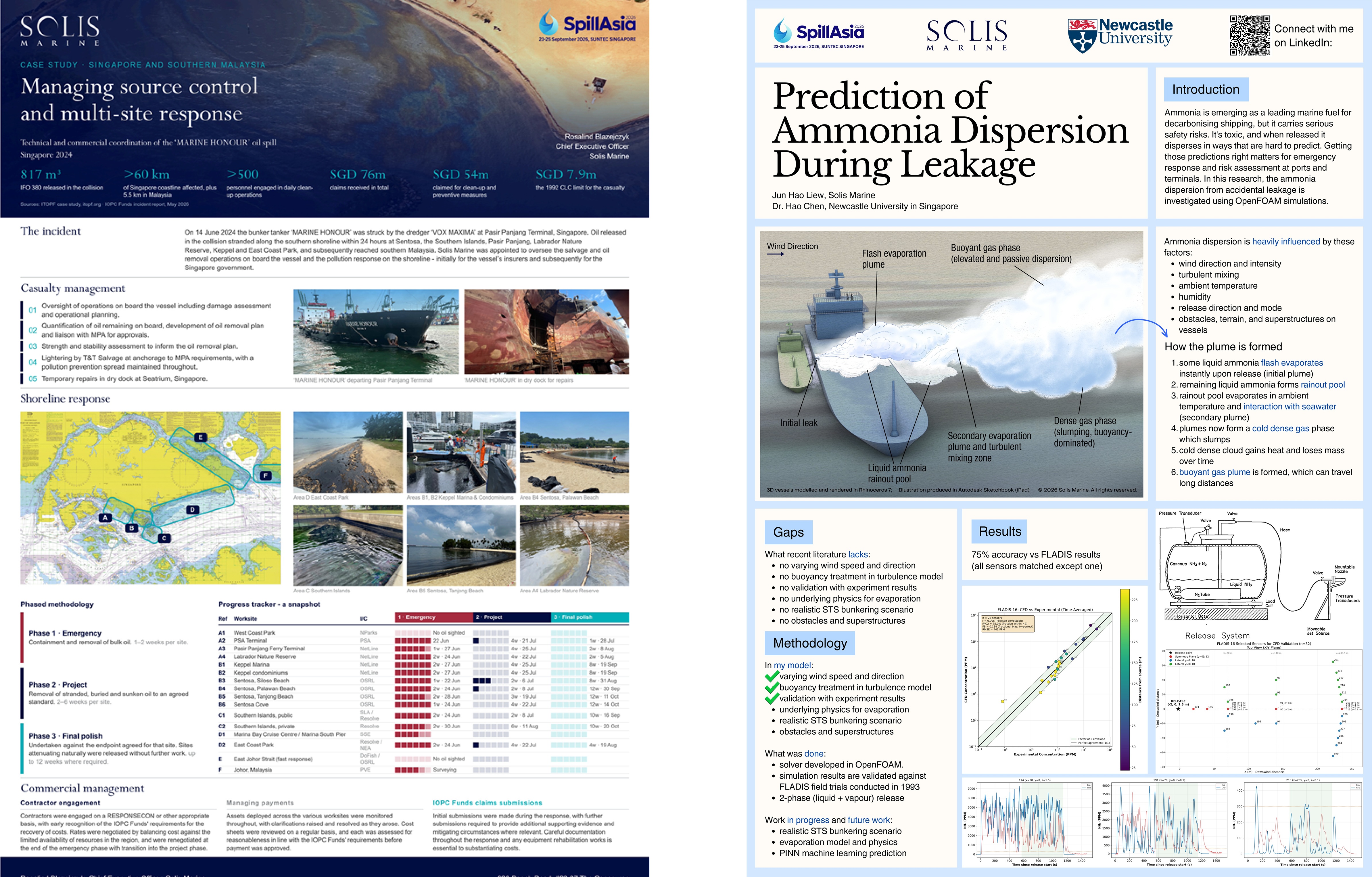
Solis Marine had two posters in the SpillAsia Poster Exhibition.
Ros’s poster summarised the ‘MARINE HONOUR’ case study.
Jun Hao Liew presented “Prediction of Ammonia Dispersion During Leakage,” co-authored with Dr Hao Chen of Newcastle University in Singapore.
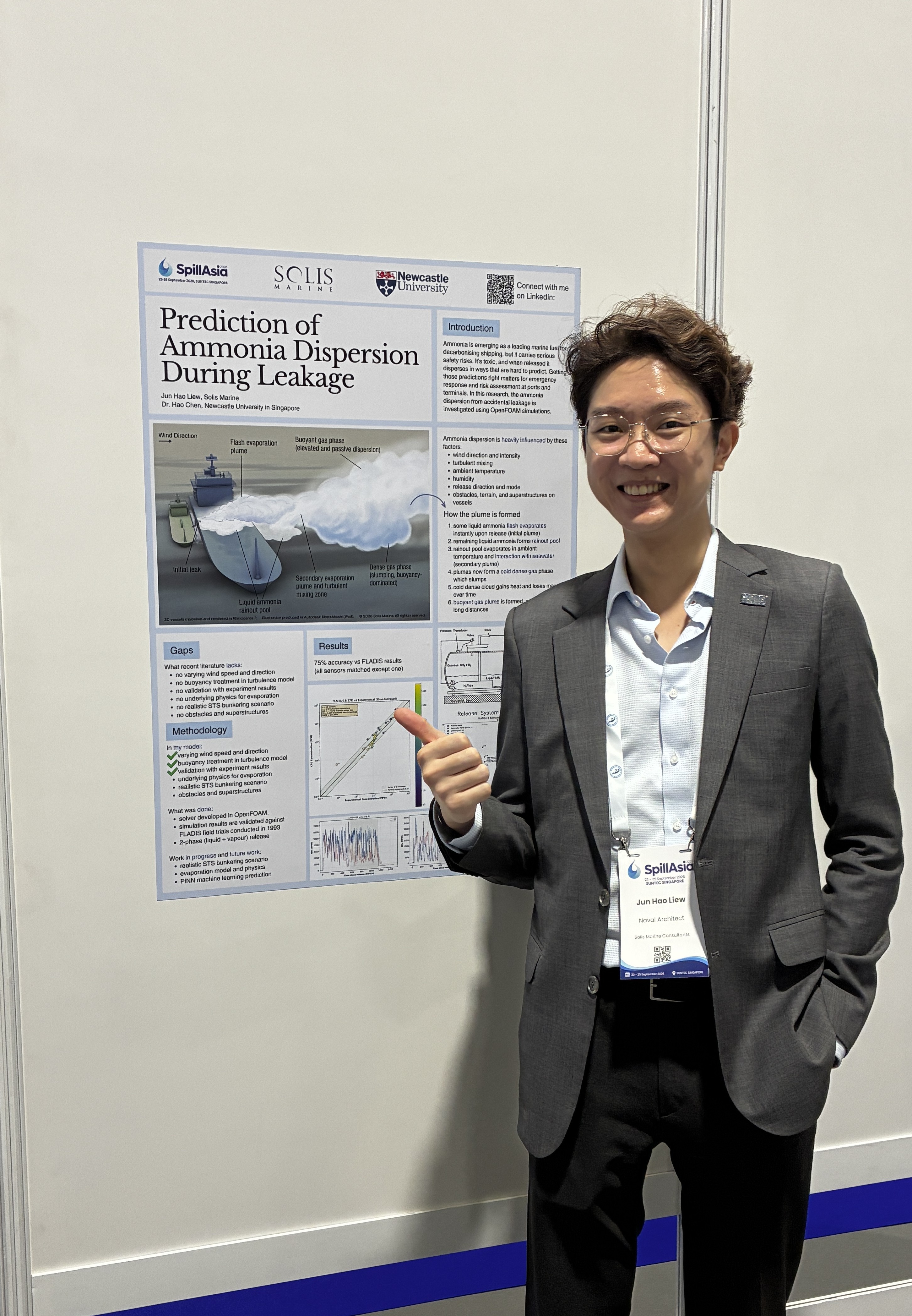
Ammonia is one of the leading candidate fuels for decarbonising shipping, and predicting how it disperses after a leak is essential for emergency planning at ports and terminals. Jun Hao has developed a solver in OpenFOAM that models a two-phase release under varying wind speed and direction, with buoyancy included in the turbulence model. Validated against the FLADIS field trials of 1993, the model achieved 75% accuracy. The next stages of the work are a realistic ship-to-ship bunkering scenario, a physical model for evaporation, and machine learning prediction using physics-informed neural networks.
This work supports the ammonia release behaviour Ros described at the IMO R&D Forum earlier in the week (see article).
Solis Marine is an independent marine consultancy providing casualty management, oil spill response, naval architecture and expert witness services worldwide. For more information, contact the team at www.solis-marine.com.