
Captain John Simpson, co-founder and principal consultant at Solis Marine, provided expert evidence on navigation standards in this English Admiralty Court case.
This article is based solely on the publicly available judgment: Unity Ship Group S.A. v Euroins Insurance JSC (The "HAPPY ARAS") [2026] EWHC 7 (Admlty). Paragraph references to specific quotations from the judgment are provided in square brackets.
Case Overview
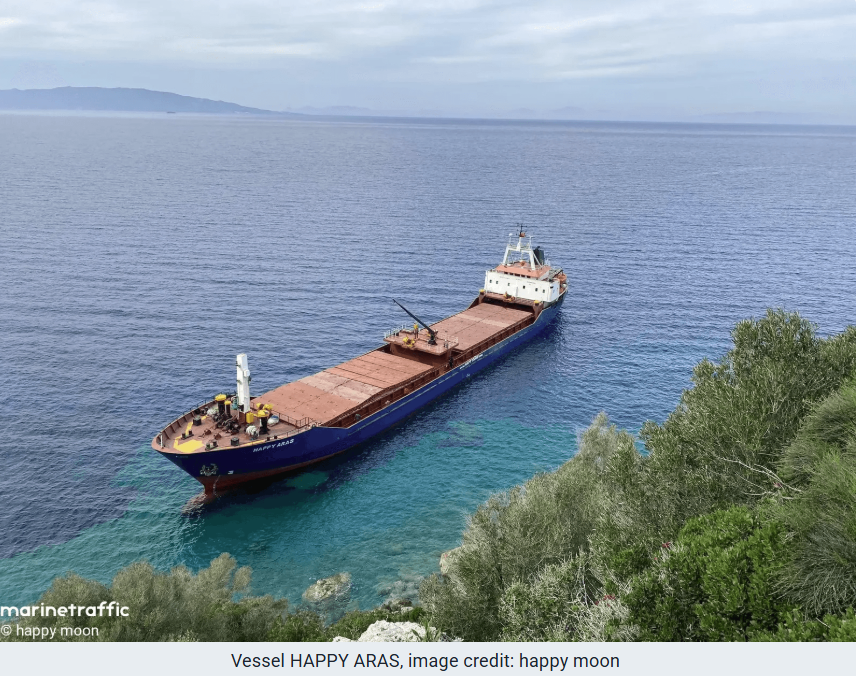
In Unity Ship Group S.A. v Euroins Insurance JSC [2026] EWHC 7(Admlty), the English Admiralty Court dismissed a US$1,271,095.89 claim for general average contributions following the grounding of the bulk carrier HAPPY ARAS off the Datca Peninsula in southern Turkey on 20 March 2023.
The vessel owners sought contributions from cargo insurers, who refused payment arguing the vessel was unseaworthy due to an incompetent Master and defective passage planning. The judgment, delivered by Admiralty Registrar Davison on 12 January 2026, centred on whether the Master's conduct demonstrated incompetence rather than mere negligence - a distinction that would determine liability under the Hague Rules.
The Incident
The HAPPY ARAS was a 2,659 gross tonne bulk carrier built in 1990 and registered in Belize. On 20 March 2023, the vessel was on the eighth day of a voyage charter from Reni, Ukraine to Mersin, Turkey with a cargo of soya beans. At 20:58, while navigating coastal waters off the Datca Peninsula (south-east of the Greek island of Kos), the vessel grounded on the north shore at full speed.
Because the vessel's tonnage was below 3,000, there was no requirement for it to be equipped with a voyage data recorder (VDR), and it was not so equipped. The investigation therefore relied on the vessel's Deck Log, Engine Log, GPS Log, a copy of the working chart, brief statements given by crew in Turkish Commercial Court proceedings, and publicly available AIS data.
A salvage, lightering and transhipment operation followed, which was not completed until 13 June 2023. The vessel owners declared General Average, which was adjusted by Blue Seas Adjusters Ltd and finalised on 3 November 2023 at US$3,140,040.97, with cargo's contribution calculated at US$1,271,095.89.
Technical Investigation
Captain Simpson's investigation evaluated the vessel's passage plan against IMO Resolution A.893(21) and the vessel's Safety Management System, and reconstructed the sequence of events using AIS data, deck logs, and the working chart.
Passage Planning and Master's Actions
The critical failures lay in the Master's actions during the hour before grounding. He failed to record position fixes as required, deviated from the passage plan without recording it, dismissed the sole lookout to make tea(breaching the vessel's SMS), missed the critical waypoint requiring a course change to 231°, and failed to keep proper lookout despite the peninsula being clearly visible.
Captain Simpson's analysis of AIS data revealed the vessel entered shallow waters at 20:57:30 at 9.4 knots and grounded at 20:58:03, leading him to conclude it "ran aground at its sailing speed without making any attempt to alter course or reduce that speed" [9].
The Deck and Engine Logs contained false entries suggesting evasive action was taken—all contradicted by AIS data. The court found these were made retrospectively to deflect blame [38].
Captain Simpson's Expert Evidence
The "Would I Sail?" Test
The most compelling moment in Captain Simpson's evidence came during the following exchange with the court:
Registrar: So, this went beyond just having a bad day, is that it?
Captain Simpson: In my belief, yes, judge. As a consultant or as a surveyor, one of the things we always do when you're carrying out a survey on a ship, the sort of rule of thumb test is, would I want to sail on it? Would I be happy sailing on this ship to the next port? And I think that's the test: I really would use every excuse in the book not to, not to cancel my taxi to the airport. And I'm very sad to say that indeed. [39]
The Admiralty Registrar noted that this answer reflected, in Captain Simpson's own language, the established legal test of unseaworthiness from The Cape Bonny [2018] 1 Lloyd's Rep 356: would a prudent owner, knowing the relevant facts, have required the defect to be made good before sending his ship to sea? [40]
Distinguishing Incompetence from Negligence
The central issue was whether the Master's failures constituted incompetence (rendering the vessel unseaworthy) or merely negligence (potentially covered by Hague Rules exceptions). The claimant argued the Master had simply had "a bad day." Captain Simpson's evidence demonstrated this characterisation was wrong, describing the conduct as "systemic failings"—crucial to the court's analysis [39].
The Court's Findings
Admiralty Registrar Davison preferred Captain Simpson's evidence to that of the claimant's expert, finding the Master was incompetent [29]. The judgment emphasised the grounding resulted from "numerous and egregious" errors amounting to "a complete dereliction of duty" [39].
The court identified the critical pattern: "The Master made multiple, serious errors; he made those errors in a context where he had, through his own actions or inactions, removed many of the checks and balances intended to maintain the safety of the vessel and the voyage; he then (I regret to find) made inaccurate and misleading entries in the vessel's records. These were systemic failings, a description applied, albeit with differences of emphasis, by both experts." [40]
The vessel owners failed to prove due diligence in appointing and supervising the Master. The evidence provided fell "a long way short of demonstrating due diligence" [44], and the burden of proof was not discharged [45-46].
While the passage plan had deficiencies, the court found these were not causative since following even the defective plan would have prevented the casualty [17, 47].
Outcome
The claim was dismissed. The defendant cargo insurers successfully defended the US$1,271,095.89 general average claim. The court noted that even if liability had been established, the capping effect of contributory values under the York-Antwerp Rules would have prevented recovery [49-50].
About Solis Marine Expert Witness Services
Solis Marine provides independent expert witness services to the maritime, offshore, and insurance industries worldwide. Our team includes master mariners, naval architects, marine engineers, and a crane engineer with extensive experience in casualty investigation, navigation analysis, and operational assessment.
We conduct rigorous technical investigations using advanced reconstruction techniques including AIS data analysis, passage plan evaluation, and compliance assessment against international standards (IMO, SOLAS, ISM Code). We provide clear, objective expert evidence for litigation, arbitration, and dispute resolution across multiple jurisdictions including English, US, Singapore, and Hong Kong courts.
Captain John Simpson is a co-founder of Solis Marine and currently serves as principal consultant. He holds a Master Mariner's Certificate of Competency and has extensive experience in casualty investigation, pilotage, tug operations and manoeuvring and expert witness work. He is also a member of the Lloyd's panel of Special Casualty Representatives (SCR).
For more information about our expert witness services contact Captain John Simpson or Ros Blazejczyk.